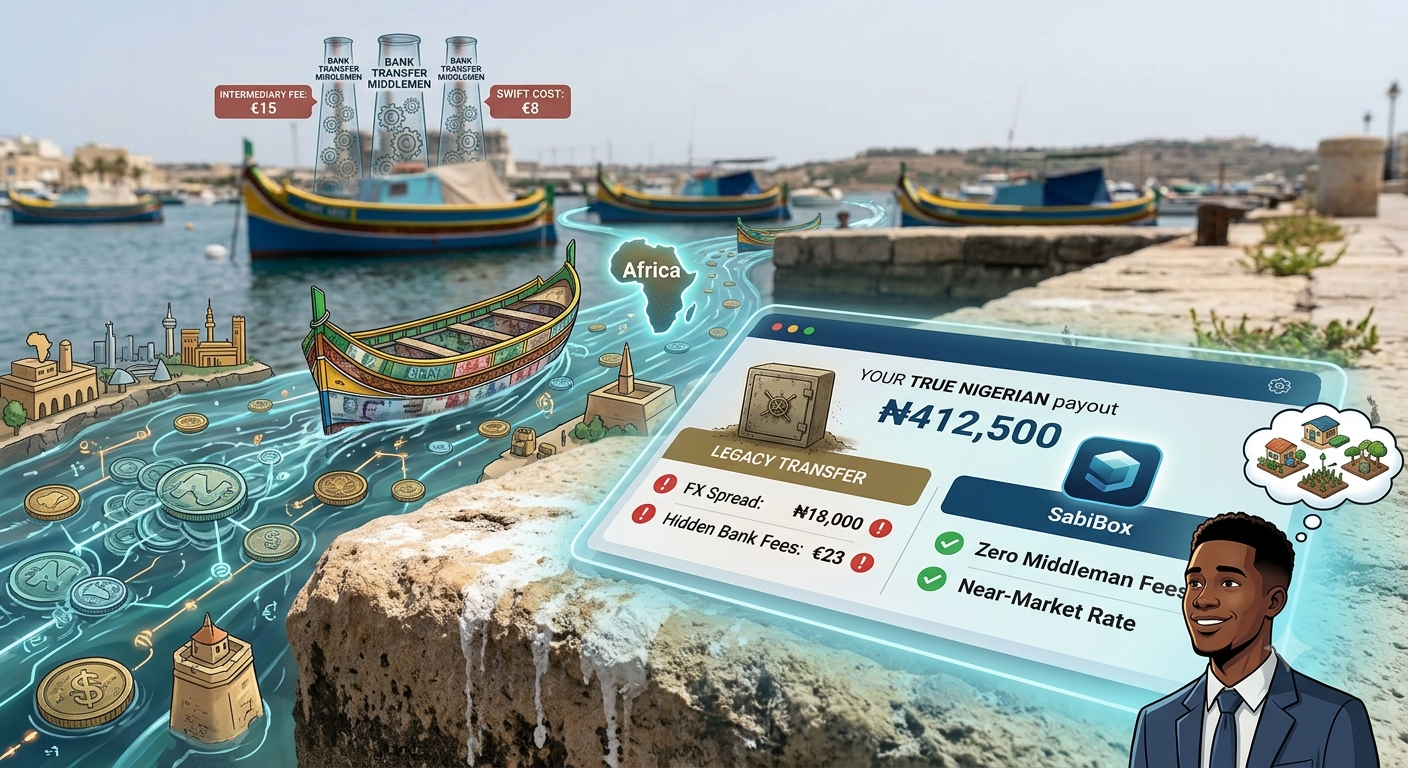
Have you ever looked at your bank statement after sending money home and felt like the math just didn’t add up?
You sent €300. The app claimed the transfer fee was only €2. But when you check how much arrived in your family’s account in Lagos, Nairobi, or Accra, it looks as though €25 magically evaporated along the way.
You aren’t imagining things. For decades, traditional financial institutions have relied on sneaky, confusing charges to maximize profits from the African diaspora. If you want to stop overpaying on hidden fees bank transfer Africa transactions, it’s time to pull back the curtain on how these hidden costs work.
Table of Contents
- Where Do These Unseen Charges Actually Come From?
- How Does the Exchange Rate Spread Hurt Your Pocket?
- What Are Intermediary and Receiving Bank Fees?
- Why Is the Remittance Cost to Africa Still So High?
- How Can SabiBox Help You Save Money on Every Transfer?
- Frequently Asked Questions
Where Do These Unseen Charges Actually Come From?
When you make an international payment, banks rarely make their profit from the upfront transfer fee alone. In fact, many banks advertise “Fee-Free Transfers” precisely to distract you from where the real profit is made.
Understanding how banks make money on international transfers comes down to three main revenue buckets:
- Upfront Administrative Fees: The advertised charge you see at checkout.
- FX Margin / Exchange Rate Spread: The markup added to the live currency exchange rate.
- SWIFT / Intermediary Bank Charges: Deductions made by handling banks in the middle of the payment route.
How Does the Exchange Rate Spread Hurt Your Pocket?
The exchange rate spread explained simply is the difference between the wholesale price of currency (what banks pay) and the retail price (what banks sell to you).
Let’s look at a quick real-world scenario:
+————————————————————-+
| REAL-WORLD FX MARGIN DEDUCTION |
+————————————————————-+
| Live Mid-Market Exchange Rate: €1 = ₦1,650 |
| Bank Offerts You: €1 = ₦1,560 |
| Hidden Margin Kept by Bank: ₦90 per Euro |
+————————————————————-+
| ON A €500 TRANSFER: |
| What You Should Get: ₦825,000 |
| What Your Bank Gives You: ₦780,000 |
| HIDDEN FX MARGIN FEE: ₦45,000 (~€27.27) |
+————————————————————-+
Without listing a single “fee” on your receipt, the bank quietly took over €27 from your transfer. If you make this transfer once a month, you are losing over €320 every single year to FX margins alone. Tracking the live [INTERNAL LINK: EUR to NGN exchange rate] is the single best way to protect yourself from this trap.
What Are Intermediary and Receiving Bank Fees?
When you send money using legacy wire services, your transfer doesn’t travel directly from your European account to Africa. It hops through intermediary banks via the SWIFT network.
Each intermediary bank that touches your money can charge a processing fee ranging from €5 to €15. To make matters worse, receiving bank transfer charges in Nigeria or Ghana might be applied when the cash finally lands, leaving your recipient with less than expected.
If you are sending money from smaller EU countries, this problem can be even worse. Read our guide on the [INTERNAL LINK: cost of sending money home from Malta] to learn how location affects transfer charges.
Why Is the Remittance Cost to Africa Still So High?
According to data published in the [EXTERNAL LINK: World Bank Remittance Cost Analysis], Sub-Saharan Africa remains one of the most expensive regions globally for cross-border money movement.
Legacy banks justify these high costs by claiming African markets are “high risk” or lack financial connectivity. But in reality, old banks simply rely on outdated systems and lack competition in traditional corridors.
+———————+———————–+———————–+
| COST ELEMENT | TRADITIONAL BANKS | SABIBOX |
+———————+———————–+———————–+
| Upfront Fee | Low / “Free” (Trick) | Transparent & Minimal |
| FX Margin | High (3% – 6%) | Near Mid-Market Rate |
| Intermediary Fees | €5 – €15 (Unpredictable)| €0 (Direct Rails) |
| Total Cost Drag | Very High | Low & Clear |
+———————+———————–+———————–+
How Can SabiBox Help You Save Money on Every Transfer?
You shouldn’t need a degree in finance just to figure out how much money your mother will receive. SabiBox was created to replace hidden fees and poor rates with total clarity.
By using local payment networks across Europe and Africa, SabiBox eliminates intermediary SWIFT banks entirely. When you initiate a transfer, SabiBox shows you:
- The exact exchange rate you are getting.
- The tiny, upfront fee (if any).
- The precise amount that will land in the recipient’s bank account or mobile wallet.
No hidden math, no post-transfer surprises, and no lost cash. Just fair, direct finance designed specifically for the African diaspora.
Frequently Asked Questions
What is an FX margin fee on international transfers?
An FX margin fee (or exchange rate spread) is the profit a bank makes by offering you an exchange rate that is lower than the live mid-market exchange rate. It is a hidden cost built directly into the currency conversion rate.
How do I know if my bank is charging hidden transfer fees?
Compare the exchange rate offered by your bank with the live rate on Google or financial market apps. If your bank’s rate gives you significantly fewer local currency units per Euro or Pound, they are charging an FX spread fee.
Why does my recipient receive less money than I sent?
If you used a traditional bank wire, intermediary banks along the SWIFT network likely deducted handling fees from the transfer amount while it was en route.
How can I avoid hidden fees on bank transfers to Africa?
Use specialized diaspora finance platforms like SabiBox that use direct local payment rails instead of SWIFT, ensuring zero intermediary fees and transparent exchange rates.
Conclusion
Overcoming hidden fees bank transfer Africa charges starts with knowing where banks conceal their profits. By skipping traditional bank wires, watching out for bad exchange rate spreads, and choosing diaspora-focused platforms, you can make sure every Euro you earn goes toward what truly matters.
Stop letting legacy banks take a bite out of your hard work.
Ready to send money home at honest rates? Join SabiBox at sabibox.com.